

DISPLAY KNOW-HOW
How to choose a frame and mount for your art print
Match your art print to the right frame, understand mount openings and avoid hiding the best bit. A practical guide to framing A-size and square prints.
By the ArtFart team · Published · 5 min read
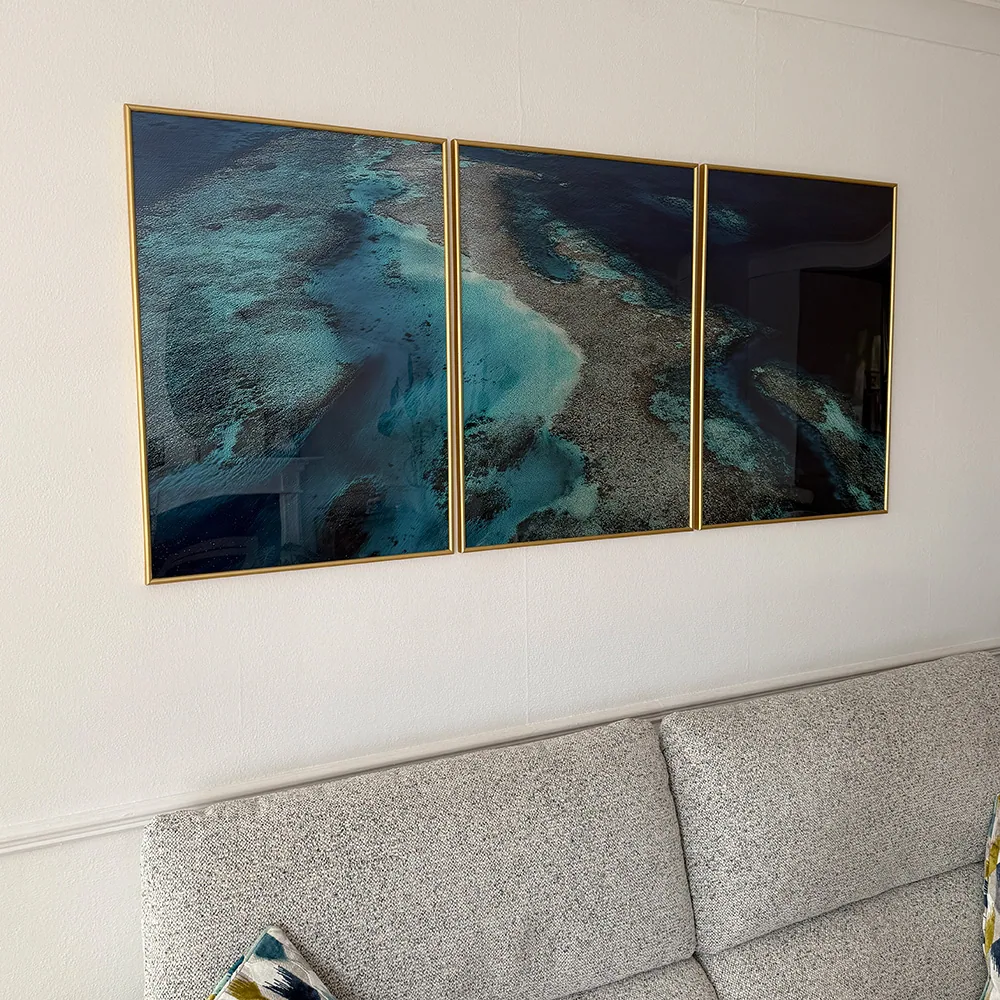
THE SHORT VERSION
Check three measurements before you buy: the print size, the frame’s artwork capacity and any mount window. Leave room for the frame or mount to overlap the edges without hiding anything important.
Choose the print and frame together
You have found an image you love. Now comes the surprisingly practical question: what will hold it on the wall? ArtFart supplies unframed prints, so choosing the frame and any mount is a separate job. A frame should finish the picture rather than become an expensive lesson in measuring.
If you already own a frame, check its specifications before ordering your print. If you are starting from scratch, settle the image shape and suitable print size first, then look for a compatible frame. Paper templates on the wall can help you judge the finished scale. Include the mount and outer frame in that footprint, not just the image.
Frame size, print size and mount opening are different things
The print size is the size of the sheet you order. A frame’s stated size often describes the artwork it can hold without a mount, but product descriptions vary. Check the maker’s dimensions rather than measuring only the outside of the decorative frame.
A mount is the board with a window cut out of it that sits around the image. It lets a smaller print sit inside a larger frame. The mount’s outside dimensions must fit the frame while its window must suit the image you want to show.
For example, a frame that holds a 30 × 40cm sheet without a mount might also include a mount intended for an A4 print. Those are two different ways of using the same frame. Read which measurement refers to the frame capacity and which refers to the mounted picture. The largest number on the label is not necessarily your print size.
Which frame sizes suit ArtFart prints?
Our A-size prints are A4 at 21 × 29.7cm, A3 at 29.7 × 42cm, A2 at 42 × 59.4cm and A1 at 59.4 × 84.1cm. They work in portrait or landscape. Look for the matching A-size artwork capacity or use a larger frame with a mount cut for that print.
Our square prints measure 21 × 21cm, 42 × 42cm and 59 × 59cm. These are not the same as 20, 40 or 60cm square. A 21cm print will not fit a frame designed to hold a 20cm sheet without alteration. A larger frame needs a suitable mount or another agreed presentation method.
Do not trim a finished print simply because the frame looked about right online. Choose a matching frame or ask a framer about a mount before ordering. For any non-standard arrangement, give them the exact print dimensions and check what will remain visible.
Allow for the edges that framing will cover
A frame’s inner lip or a mount window usually overlaps the sheet slightly. A mount opening can therefore be a little smaller than the print it is designed to hold. Check the actual visible opening, particularly if your picture has lettering, a signature or a fine border near an edge.
Keep essential details comfortably inside the crop when preparing your image. Do not assume a white border or extra framing margin will be added automatically. Review the ArtFart crop preview and ask us before ordering if your intended frame needs a particular layout.
The same check matters for a group photograph. Your frame should not quietly demote the person at the end of the row. If the image cannot spare any edge at all, discuss a presentation that keeps the full sheet visible with a framer.
Give the print a little breathing room
For paper prints, ask for conservation-quality mountboard and backing materials. Everyday cardboard and household sticky tape can stain paper over time. A framer can advise on suitable reversible attachments rather than sticking the whole print permanently to a board.
The printed surface should be kept away from the glass or acrylic glazing. A suitably deep window mount provides that gap. If you prefer the look without a mount, ask about spacers that separate the print from the glazing. Check that the frame is deep enough to hold the complete assembly.
Think about the glazing as well as the paper finish
ArtFart’s 250gsm Semi Gloss has a smooth surface with a slight shine. Ultrasmooth fine art paper has a smooth matt finish. Both can be framed, but putting matt paper behind ordinary glass does not remove reflections from the glass itself.
View the proposed position from where you will normally sit or stand. If a window or lamp dominates the reflection, try another position or ask a framer about glazing options. Reduced-reflection and UV-filtering properties are different features, so check what a particular product actually offers.
Choose a dry position away from direct sunlight and strong heat sources such as radiators. Protective glazing helps, but it does not make a print immune to light or poor display conditions. Handle unframed prints by the edges with clean, dry hands and avoid touching the image surface.
What if I choose Satin Canvas?
ArtFart’s Satin Canvas is supplied as printed canvas without stretching or a frame. It needs a different finishing plan from a paper print. Speak to your framer before ordering if you want it stretched over bars.
Stretching requires material around the visible image to wrap around the bars. Do not assume the selected print size includes that extra allowance. Ask us about your intended finished size and the framer’s requirements first. A canvas cannot acquire spare edges through optimism.
The quick framing checklist
Confirm the exact print dimensions and orientation. Check the frame’s artwork capacity, any mount’s outside size and its visible window. Make sure important parts of the picture will not be hidden. Choose suitable mounting materials and a gap between paper and glazing.
Finally, check the whole framed size against your wall space and arrange hanging fittings suitable for the frame’s weight and the wall. If you are unsure about the print layout, email info@artfart.co.uk before ordering. A tape measure is a very small investment in avoiding a very specific disappointment.
Ready to make it real?
Upload your image and find the size and finish that work for it.
Upload Your ArtAsk the ArtFart teamA bit more know-how.
All guides →
How to scan old photos for printing
Turn an old family photograph into a printable file with sensible scanning, gentle editing and a print size that respects the detail in the original.
Read the guide →
Should I upscale my AI image before printing?
Learn when an AI image needs upscaling for print, what ArtFart’s 2× tool changes and which details to check before choosing the enlarged file.
Read the guide →